Ad Tech|Index 02
The CMS as AI’s Central Command for Brands by 2026
MarTech.org predicts Content Management Systems will evolve beyond content storage to become the primary hub for AI-driven content discovery, governance, and personalization. This redefines the strategic role of content platforms.
- Via
- ADVERTISE TOKYO Editors
- Dateline
- TOKYO, July 8, 2026
- Date
- July 8, 2026
- Time
- 6 min read
Source
MarTech.org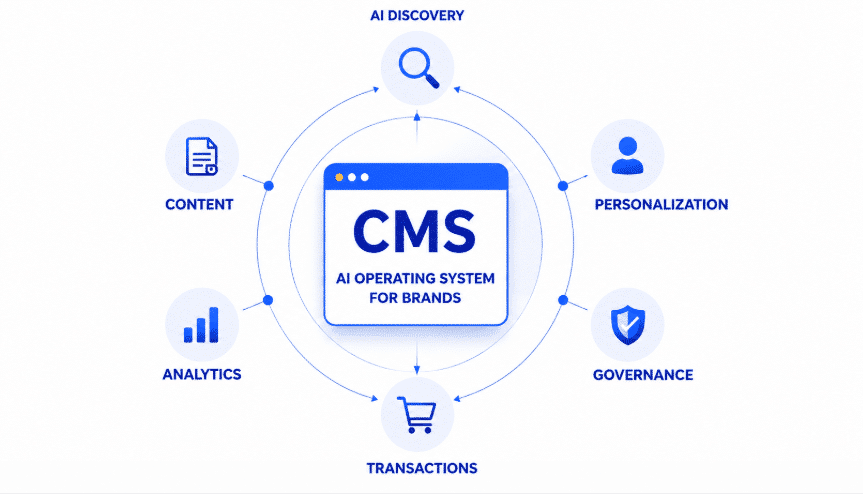
Tagline
CMS becomes the AI content hub by 2026.
Who & For What
For a Tokyo-based brand manager or content strategist evaluating martech stacks, this report outlines how future CMS decisions will centralize AI-driven content workflows and personalization across channels.
vs. Japan Play
While Japanese CDPs like KARTE already focus on personalization, this vision positions the CMS as the *creation and governance* layer for AI content, a role currently more fragmented across creative agencies and internal teams in Japan.
Tokyo Take
Tokyo marketers should track how domestic CMS vendors like HeartCore or global players' Japan branches adapt their roadmaps to integrate AI content governance and personalization at scale, beyond simple text generation.
MarTech.org projects that by 2026, the Content Management System (CMS) will transition from a mere repository into the primary AI operating system for brands. This shift indicates that CMS platforms are poised to become the central orchestration layer for all AI-driven content workflows, moving far beyond traditional publishing functions.
The core of this evolution lies in the expanded capabilities expected from future CMS solutions. They are anticipated to integrate advanced features for AI-driven content discovery, ensuring relevant assets are easily found; robust governance, maintaining brand safety and compliance across diverse markets; comprehensive personalization, tailoring experiences at scale; and even the deployment and management of autonomous AI agents for various marketing tasks.
This means marketers evaluating their content technology stack will need to prioritize AI integration roadmaps over raw publishing features. The focus will move to how a CMS handles prompt engineering for content generation, manages multiple AI-generated asset versions, and ensures data privacy and regulatory compliance for personalized outputs. It signifies a convergence where content creation, distribution, and optimization become intrinsically linked through AI within a single platform.
While the concept of AI assisting content creation is not new, the projection of the CMS as an 'AI operating system' suggests a deeper, more active role. It implies the platform will not just host content, but actively manage its lifecycle through AI, from ideation and generation to deployment and performance analysis. This contrasts with current approaches where AI tools are often separate, requiring manual integration or data transfers.
Choosing a CMS now means preparing for AI discovery, governance, personalization, and agents.
This trend aligns with a broader industry movement towards consolidating martech capabilities. Where Customer Data Platforms (CDPs) centralize customer data and Digital Experience Platforms (DXPs) manage customer journeys, the future CMS aims to be the central brain for AI-driven content intelligence. The challenge for vendors will be to deliver these integrated capabilities in a way that provides tangible ROI beyond novelty, proving their efficacy in real-world marketing scenarios.
Ultimately, this evolution calls for a re-evaluation of content strategy itself. Brands will need to consider how their organizational structures and workflows can adapt to a CMS that actively participates in content creation and personalization. The success of this shift will depend on the platform's ability to seamlessly integrate with other martech tools and provide intuitive controls for managing complex AI processes.
Related Stories

Ad Tech
AI Code Needs Process, Not Just Prompts
The focus for AI-generated code shifts from prompt engineering to maintainability and governance, with 'prompt logs' emerging as a solution.
Ad Tech
AI in CX: Adoption Nears Universal, Deployment Paths Diverge
Despite near-universal AI adoption in customer experience, companies are split on architecture, governance, and trust, struggling to prove clear ROI.

Ad Tech
Meta Mandates Granular AI Ad Disclosure
Meta is rolling out updated disclosure tags for ads containing AI-generated elements, differentiating between content made with its own tools and those from external AI applications, effective July 9, 2026. This move aims to enhance transparency and manage the growing use of generative AI in advertising creative.